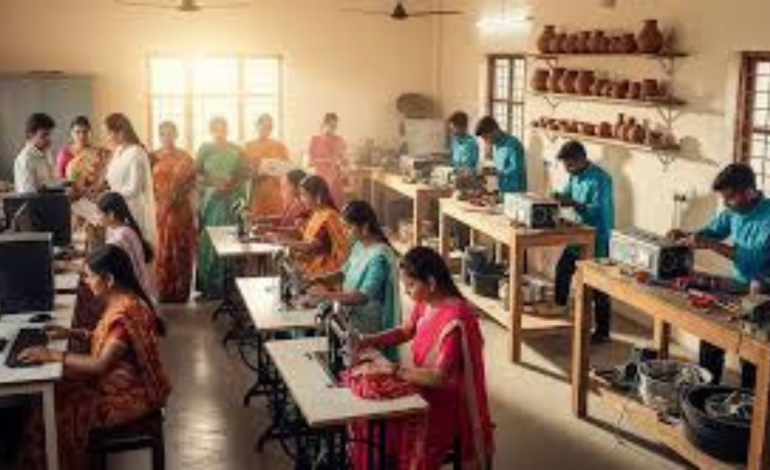

India’s education system has long been divided between academic learning and skills-based training, a gap that began during the colonial era when degrees were valued more than vocational skills. Even though policies in 1968 and 1986 tried to promote skill education, weak implementation kept this divide alive. As a result, India continues to face youth unemployment, a shortage of skilled workers, and limited hands-on training opportunities.
The National Education Policy (NEP) 2020 aims to change this by integrating vocational education into every level of schooling starting from Grade 6, breaking the rigid separation between academic and skill development. NEP also focuses on strong connections with industry, ensuring students learn skills that match real workplace needs.
🇮🇳 Why India Needs Strong Vocational Education
India has one of the world’s largest youth populations. To support this demographic, the country must offer high-quality skill training. The goal is to ensure 50% of students gain practical skills by 2025.
To achieve this target, India needs:
- Modern practical training facilities
- Strong industry partnerships
- Flexible learning through the Academic Bank of Credits (ABC)
- Clear pathways under the National Skills Qualification Framework (NSQF)
These steps create a smooth bridge between school, college, and future careers.
🏫 Strengthening Institutions for Future Skills
Institutions like the PSSCIVE (Postgraduate Centre for Science, Vocational and Technical Education) are being modernised to update courses and make them industry-ready.
Higher education is now moving toward multidisciplinary universities capable of responding to the challenges of AI, automation, and Industry 4.0. Schemes like RUSA and PM-USHA support this transformation.
The Hub and Spoke Model encourages partnerships between schools, colleges, and nearby industries, giving students real community-based learning experiences.
🤝 Industry–Academia Collaboration: The Heart of NEP 2020
For vocational education to succeed, India needs strong coordination between industry and academic institutions.
Key players include:
- Sector Skill Councils (SSCs)
- AICTE
- Industry experts offering reverse mentoring
- Apprenticeships under PM National Apprenticeship Promotion Scheme (PM-NAPS)
Apprenticeship incentives encourage companies to train students. However, strict monitoring is needed to ensure students gain real skills, not just temporary work experience.
🧰 Focus on Practical and Experiential Learning
Hands-on learning is central to NEP 2020. Through schemes like Samagra Shiksha, students participate in:
- On-the-Job Training (OJT)
- Field visits
- Skill workshops
- Industry projects
Hybrid learning models are also expanding. For example, Pratham NGO has trained more than 1.5 lakh students using online theory and offline practical sessions, creating a scalable model for the future.
🚀 Building Entrepreneurial and Future-Ready Students
Vocational education is not just about jobs; it also nurtures entrepreneurship, creativity, and innovation. Exposure to new technologies—like Artificial Intelligence, IoT, and modern manufacturing—helps students become future-ready innovators.
Companies benefit too, as they gain access to young talent early, while students graduate with confidence and market-relevant skills.
⚠️ Challenges That Still Need Attention
Even with strong policies, India faces several barriers:
- Shortage of trained vocational teachers
- Limited infrastructure
- Low industry participation in rural areas
- Rapid technological changes
- Lack of awareness among MSMEs
To overcome these challenges, India must improve faculty development, boost industry partnerships, and strengthen MSME engagement through incentives, digital platforms, and simpler processes.
🏗️ Ensuring Quality Through Strong Regulation
Bodies such as NCVET, NCrF, and accreditation agencies must maintain strict quality checks.
Funding under RUSA, PM-USHA, and credit recognition through NCrF should be linked to:
- Verified skill outcomes
- Employment data
- Entrepreneurial success rates
- Industry feedback
This ensures accountability and strengthens partnerships.
🔮 The Road Ahead: Priorities for 2025–2030
1. Build Stronger Faculty
Encourage:
- Faculty exchange programs
- Industry expert involvement
- Continuous skill upgrades
2. Expand Local Partnerships
Support MSMEs with:
- Financial incentives
- Logistics support
- Local Hub and Spoke networks
- Awareness drives about government schemes
3. Adopt Outcome-Based Governance
Use real-time data to measure:
- Skill certifications
- Employment rates
- Start-up outcomes
- Industry satisfaction
🧭 Conclusion
The NEP 2020 is a powerful roadmap for transforming India’s vocational education system. With strong industry collaboration, updated infrastructure, skilled faculty, and inclusive partnerships, India can build a generation of tech-savvy, job-ready, and innovative youth equipped to thrive in an AI-driven economy.