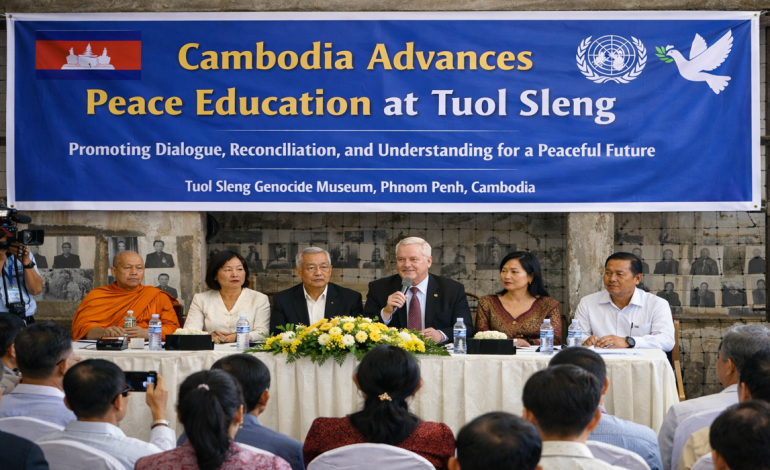

How can education prevent violence and promote lasting peace? This question guided a recent Peace Education Assessment Workshop at the Tuol Sleng Genocide Museum (TSGM). UNESCO organized the event in partnership with Cambodia’s Ministry of Culture and Fine Arts (MoCFA), Ministry of Education, Youth and Sport (MoEYS), and TSGM. The workshop is part of the PEACE Project, funded by the Korea International Cooperation Agency (KOICA).
The workshop brought together 35 participants, including government officials, educators, civil society representatives, and development partners. They reviewed and validated the findings of Cambodia’s Peace Education Assessment and discussed ways to strengthen peace education in schools and memorial sites.
Evidence and Collaboration Drive Peace Education
The Peace Education Assessment is central to the PEACE Project. The first phase preserved and digitized over 700,000 archival pages from TSGM. The second phase now focuses on peace education, youth engagement, and heritage site conservation.
The assessment looked at three main areas:
- Youth knowledge and understanding of peace and historical memory.
- Lessons from existing peace education programs.
- Ways to integrate peace education at memorial sites like Tuol Sleng, Choeung Ek, and M-13.
The workshop highlighted progress and challenges, such as unequal access to programs, different teaching methods, and lack of coordination among institutions.
Key Priorities from Discussions
Participants discussed priority actions to improve peace education. Main themes included:
- Linking classroom learning with site visits to memorials.
- Training teachers and facilitators to address sensitive histories.
- Using memorial sites as spaces for reflection, dialogue, and civic learning.
- Ensuring sustainability and coordination across institutions.
Stakeholders supported the assessment’s recommendations and shared ideas for youth-focused projects. They suggested creating interactive, engaging learning tools to help young people reflect on Cambodia’s post-conflict future and build an inclusive society.
Collaboration between formal and informal institutions emerged as a key approach to strengthen peace education programs.
Next Steps for the PEACE Project
The assessment recommends turning memorial sites into youth-centered learning hubs connected to the education system. These hubs will promote peace, global citizenship, and critical thinking both in classrooms and online.
Feedback from the workshop will refine site-specific and cross-site recommendations. It will guide the future of peace education programming, interpretation, and coordination at TSGM, Choeung Ek, and M-13.
UNESCO reaffirmed its commitment to working with authorities, educators, and development partners to make peace education a foundation for reconciliation, social cohesion, and sustainable development.
The PEACE Project shows how heritage, education, and youth engagement can work together to build a peaceful and informed future for Cambodia.