
Danielle Spence’s Research Bridges Science and Society
For Danielle Spence, a recent graduate of the University of Saskatchewan’s (USask) School of Environment and Sustainability (SENS), water security is more than scientific data — it’s about understanding the climate’s story and how it affects people and ecosystems.
Her groundbreaking research focused on two critical Canadian regions: Buffalo Pound Lake in southern Saskatchewan and Elk/Beaver Lake in British Columbia. Both waterbodies have been facing increasing algal blooms, posing threats to water quality, local communities, and ecosystems.
From Data Collection to Community Engagement
Spence began with traditional fieldwork and data analysis, but her research quickly expanded beyond the lab. She engaged with government agencies, water utilities, and community members, combining scientific modeling with local knowledge.
“It was as much about the environment’s long-term health as it was about the social impact,” said Spence, who recently defended her doctoral thesis and will officially graduate at USask’s Fall Convocation.
Her empathetic approach became the foundation of her four-year research journey, blending natural science with social understanding — a core value of SENS.
Interdisciplinary Approach to Climate and Water Quality
At Buffalo Pound Lake, Spence analyzed nearly four decades of data using generalized additive models. Her goal was to understand how climate oscillations, water flow management, and nutrient levels interact to influence phytoplankton growth, which causes harmful algal blooms.
At Elk/Beaver Lake, recreational activities have often been suspended due to toxic algal blooms. Spence worked closely with communities to study their preferences and willingness to pay for lake restoration, aiming to reduce bloom frequency and improve water safety.
Why Algal Blooms Are a Growing Threat
Harmful algae growth has serious consequences:
- Disrupts aquatic ecosystems
- Causes fish kills
- Triggers drinking water advisories
- Suspends recreational activities
By identifying how droughts and wet periods affect water quality, Spence developed strategic recommendations for better water management.
“There’s a critical need to address water quality issues — not just for drinking water, but for all the benefits lakes provide,” she said.
Research with Real-World Impact
Spence’s findings are relevant not only in policy-making but also in community spaces. By merging technical models with local voices, she ensured her research influenced government decisions, watershed planning, and public awareness.
She also contributed to academia through teaching. As a teaching assistant and award-winning instructor, she simplified complex environmental science for students and inspired many to pursue careers in sustainability.
“I had never felt confident in the field before, but her course changed everything,” shared a former student.
This student-centered approach reflects Spence’s belief that learners are partners in discovery and agents of change.
Recognition and Academic Excellence
Spence and her co-supervisor, Dr. Helen Baulch (PhD), received the 2025 Provost’s College Award for Outstanding Teaching. Dr. Baulch praised her ability to integrate social and natural sciences, calling her a “tremendous academic” who answered key climate and water management questions.
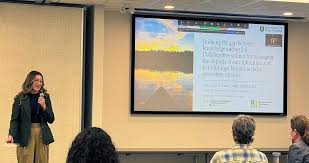
Her PhD defence in September 2025 was a celebrated event, attended by industry partners, SENS faculty, staff, and family, reflecting her deep impact on both academic and community circles.
A Roadmap for Future Water Management
Spence’s research provides clear steps for governments, watershed managers, and local stakeholders to anticipate extreme weather and restore waterbodies:
- In southern Saskatchewan, managing nutrient runoff during floods can help align policy decisions with community needs.
- In British Columbia, understanding community preferences supports more socially relevant and economically efficient lake restoration.
Her work is a reminder that science becomes stronger when connected with people. By pairing long-term data with human stories, Spence created a model for resilient, community-driven environmental solutions.